# Gadget Functions
# RGB LED Matrix
Purpose Of This Page
This page explains how to control the 4 by 4 RGB LED Matrix on the CodyJoy Pro using Python.
By the end of this page, students will be able to:
- Turn on one RGB LED by LED number.
- Turn on one RGB LED by `(x, y)` coordinate.
- Use built-in color codes.
- Use RGB hex colors.
- Use RGB percentage colors.
- Clear all RGB LEDs.
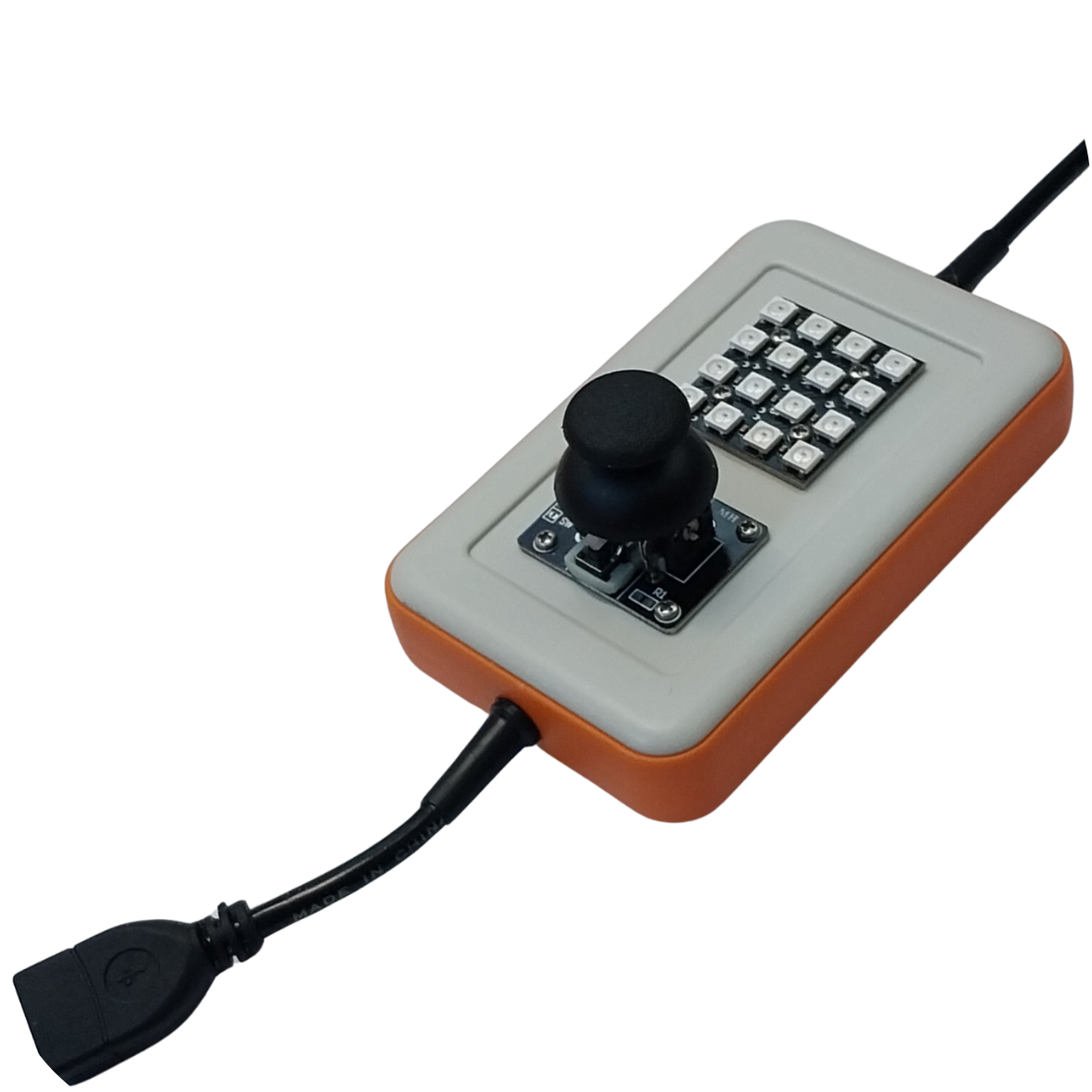
Figure 1 - CodyJoy Pro with the 4 by 4 RGB LED Matrix.
Start Code
Every CodyNick Python script should import the CodyNick library and connect to the CodyNick device.
```python
import CodyNick
cn = CodyNick.CN()
```
The variable `cn` represents the connected CodyNick device. It is passed to the CodyNick functions so Python knows which device to control.
RGB LED Number Layout
The CodyJoy Pro RGB LEDs are numbered as shown below:
```text
15 14 13 12
8 9 10 11
7 6 5 4
0 1 2 3
```
Important positions:
- LED `0` is the bottom-left LED.
- LED `3` is the bottom-right LED.
- LED `15` is the top-left LED.
- LED `12` is the top-right LED.
Turn On One LED By Number
Use `RGB_Matrix.set()` to turn on one LED.
Function format:
```python
CodyNick.RGB_Matrix.set(cn, led_number, color)
```
Example:
```python
import CodyNick
cn = CodyNick.CN()
CodyNick.RGB_Matrix.set(cn, 15, "#FF0000")
```
This turns LED `15` red.
Another example:
```python
CodyNick.RGB_Matrix.set(cn, 0, "#00FF00")
```
This turns LED `0` green.
Clear The RGB Matrix
Use `RGB_Matrix.clear()` to turn off all RGB LEDs.
```python
CodyNick.RGB_Matrix.clear(cn)
```
Example:
```python
import CodyNick
import time
cn = CodyNick.CN()
CodyNick.RGB_Matrix.set(cn, 15, "#FF0000")
time.sleep(1)
CodyNick.RGB_Matrix.clear(cn)
```
This turns LED `15` red for one second, then turns all LEDs off.
Built-In Color Codes
The easiest way to choose a color is to use one of the built-in color codes from `0` to `7`.
| Code | Name | Hex |
|---:|---|---|
| 0 | Red | `#FF0000` |
| 1 | Cyan | `#00FFFF` |
| 2 | Blue | `#0000FF` |
| 3 | Yellow | `#FFFF00` |
| 4 | Magenta | `#FF00FF` |
| 5 | Green | `#00FF00` |
| 6 | Orange | `#FF8000` |
| 7 | White | `#FFFFFF` |
Example:
```python
import CodyNick
cn = CodyNick.CN()
CodyNick.RGB_Matrix.set(cn, 15, 0)
```
This turns LED `15` red, because color code `0` means red.
RGB Hex Colors
Students can also use RGB hex colors.
An RGB hex color starts with `#` and has six hexadecimal characters:
```python
"#RRGGBB"
```
`RR` controls red, `GG` controls green, and `BB` controls blue.
Common examples:
| Color | Hex |
|---|---|
| Red | `#FF0000` |
| Green | `#00FF00` |
| Blue | `#0000FF` |
| Cyan | `#00FFFF` |
| Yellow | `#FFFF00` |
| Magenta | `#FF00FF` |
| White | `#FFFFFF` |
Example:
```python
import CodyNick
cn = CodyNick.CN()
CodyNick.RGB_Matrix.set(cn, 12, "#00FFFF")
```
This turns LED `12` cyan.
RGB Percentage Colors
Students can also describe a color with red, green, and blue percentages.
Format:
```python
[red_percent, green_percent, blue_percent]
```
Each number must be between `0` and `100`.
Examples:
| Color Input | Meaning |
|---|---|
| `[100, 0, 0]` | 100% red |
| `[0, 100, 0]` | 100% green |
| `[0, 0, 100]` | 100% blue |
| `[0, 100, 100]` | cyan |
| `[100, 100, 0]` | yellow |
| `[50, 0, 0]` | dim red |
Example:
```python
import CodyNick
cn = CodyNick.CN()
CodyNick.RGB_Matrix.set(cn, 10, [0, 100, 100])
```
This turns LED `10` cyan.
Coordinate Layout
Students can also control LEDs by `(x, y)` coordinate.
The bottom-left LED is `(0, 0)`.
The top-right LED is `(3, 3)`.
```text
(0,3) (1,3) (2,3) (3,3)
(0,2) (1,2) (2,2) (3,2)
(0,1) (1,1) (2,1) (3,1)
(0,0) (1,0) (2,0) (3,0)
```
Use `RGB_Matrix.set_xy()` to control one LED by coordinate.
Function format:
```python
CodyNick.RGB_Matrix.set_xy(cn, x, y, color)
```
Example:
```python
import CodyNick
cn = CodyNick.CN()
CodyNick.RGB_Matrix.set_xy(cn, 0, 0, "#FF0000")
```
This turns the bottom-left LED red.
Another example:
```python
CodyNick.RGB_Matrix.set_xy(cn, 3, 3, 2)
```
This turns the top-right LED blue, because color code `2` means blue.
Example: Four Corners
This example lights the four corner LEDs with different colors.
```python
import CodyNick
cn = CodyNick.CN()
CodyNick.RGB_Matrix.clear(cn)
CodyNick.RGB_Matrix.set_xy(cn, 0, 0, 0) # bottom-left red
CodyNick.RGB_Matrix.set_xy(cn, 3, 0, 5) # bottom-right green
CodyNick.RGB_Matrix.set_xy(cn, 0, 3, 2) # top-left blue
CodyNick.RGB_Matrix.set_xy(cn, 3, 3, "#FFFF00") # top-right yellow
```
Example: Show All Built-In Colors
This example shows all eight built-in colors one by one.
```python
import CodyNick
import time
cn = CodyNick.CN()
for color_code in range(8):
CodyNick.RGB_Matrix.clear(cn)
CodyNick.RGB_Matrix.set(cn, color_code, color_code)
time.sleep(0.5)
```
In this loop, the LED number and the color code are both using `color_code`.
Example: Center LEDs
The center four LEDs are:
```text
(1,2) (2,2)
(1,1) (2,1)
```
Example:
```python
import CodyNick
cn = CodyNick.CN()
CodyNick.RGB_Matrix.clear(cn)
CodyNick.RGB_Matrix.set_xy(cn, 1, 1, "#FF0000")
CodyNick.RGB_Matrix.set_xy(cn, 2, 1, "#00FF00")
CodyNick.RGB_Matrix.set_xy(cn, 1, 2, "#0000FF")
CodyNick.RGB_Matrix.set_xy(cn, 2, 2, "#FFFFFF")
```
Practice Tasks
Try these exercises:
1. Turn on LED `0` in red.
2. Turn on LED `12` in blue.
3. Clear the matrix after two seconds.
4. Turn on all four corners with different colors.
5. Use `set_xy()` to light the center four LEDs.
6. Create a loop that moves one light from LED `0` to LED `15`.
7. Use percentage colors to make dim red, dim green, and dim blue.
Common Mistakes
Hex colors must be written as strings:
```python
CodyNick.RGB_Matrix.set(cn, 0, "#FF0000")
```
This is not correct:
```python
CodyNick.RGB_Matrix.set(cn, 0, #FF0000)
```
Color percentages must use numbers from `0` to `100`:
```python
CodyNick.RGB_Matrix.set(cn, 0, [100, 50, 0])
```
Coordinates must be between `0` and `3`:
```python
CodyNick.RGB_Matrix.set_xy(cn, 3, 3, 7)
```
This is outside the matrix:
```python
CodyNick.RGB_Matrix.set_xy(cn, 4, 0, 7)
```
If old LEDs stay on, clear the matrix before drawing the next pattern:
```python
CodyNick.RGB_Matrix.clear(cn)
```
Page summary:
The RGB LED Matrix can be controlled by LED number or by `(x, y)` coordinate. Colors can be written as built-in color codes, RGB hex values, or RGB percentage lists.
# Joystick
Purpose Of This Page
This page explains how to read the CodyJoy Pro joystick using Python.
The CodyJoy Pro includes several built-in features, including:
- RGB LED Matrix.
- Joystick.
- Sound Maker.
This page focuses only on the joystick.
By the end of this page, students will be able to:
- Detect joystick direction.
- Detect joystick button clicks.
- Read all joystick states at once.
- Use joystick input inside a Python loop.
Figure 1 - CodyJoy Pro device. The board includes an RGB LED Matrix, joystick, and Sound Maker.
Start Code
Every CodyNick Python script should import the CodyNick library and connect to the CodyNick device.
```python
import CodyNick
cn = CodyNick.CN()
```
The variable `cn` represents the connected CodyNick device.
Joystick Directions
The joystick can be moved in four main directions:
- Up
- Down
- Left
- Right
The joystick can also be pressed like a button. This is called a click.
Check One Direction
Use `Joystick.position()` to check one direction.
Function format:
```python
CodyNick.Joystick.position(cn, direction)
```
The direction should be one of:
```python
"up"
"down"
"left"
"right"
```
Example:
```python
import CodyNick
cn = CodyNick.CN()
if CodyNick.Joystick.position(cn, "up"):
print("Joystick is up")
```
This prints a message if the joystick is moved up.
Check For A Click
Use `Joystick.click()` to check whether the joystick button is pressed.
Function format:
```python
CodyNick.Joystick.click(cn)
```
Example:
```python
import CodyNick
cn = CodyNick.CN()
if CodyNick.Joystick.click(cn):
print("Joystick clicked")
```
Read All Joystick States
Use `Joystick.states()` to read the current joystick state once.
Function format:
```python
CodyNick.Joystick.states(cn)
```
This returns a list.
Examples of possible results:
| Result | Meaning |
|---|---|
| `[]` | No direction or click |
| `["UP"]` | Joystick is moved up |
| `["DOWN"]` | Joystick is moved down |
| `["LEFT"]` | Joystick is moved left |
| `["RIGHT"]` | Joystick is moved right |
| `["CLICK"]` | Joystick button is pressed |
| `["UP", "CLICK"]` | Joystick is moved up and clicked |
Example:
```python
import CodyNick
cn = CodyNick.CN()
states = CodyNick.Joystick.states(cn)
print(states)
```
Example: Print Joystick Movement
This example continuously checks the joystick and prints the direction.
```python
import CodyNick
import time
cn = CodyNick.CN()
while True:
if CodyNick.Joystick.position(cn, "up"):
print("up")
if CodyNick.Joystick.position(cn, "down"):
print("down")
if CodyNick.Joystick.position(cn, "left"):
print("left")
if CodyNick.Joystick.position(cn, "right"):
print("right")
if CodyNick.Joystick.click(cn):
print("click")
time.sleep(0.1)
```
The `time.sleep(0.1)` line slows the loop down slightly. Without it, Python may print too many messages very quickly.
Example: Read Once Per Loop
For larger programs, it is often better to read the joystick once per loop using `states()`.
```python
import CodyNick
import time
cn = CodyNick.CN()
while True:
states = CodyNick.Joystick.states(cn)
if "UP" in states:
print("up")
elif "DOWN" in states:
print("down")
elif "LEFT" in states:
print("left")
elif "RIGHT" in states:
print("right")
elif "CLICK" in states:
print("click")
time.sleep(0.1)
```
This style is useful when one program needs to react to different joystick actions.
Example: Count Button Clicks
This example counts how many times the joystick button is clicked.
```python
import CodyNick
import time
cn = CodyNick.CN()
click_count = 0
was_clicked = False
while True:
is_clicked = CodyNick.Joystick.click(cn)
if is_clicked and not was_clicked:
click_count = click_count + 1
print("Clicks:", click_count)
was_clicked = is_clicked
time.sleep(0.05)
```
The variable `was_clicked` helps count one click at a time instead of counting the same press many times.
Function Summary
| Function | Purpose | Example |
|---|---|---|
| `Joystick.position(cn, "up")` | Check if joystick is up | `if Joystick.position(cn, "up"):` |
| `Joystick.position(cn, "down")` | Check if joystick is down | `if Joystick.position(cn, "down"):` |
| `Joystick.position(cn, "left")` | Check if joystick is left | `if Joystick.position(cn, "left"):` |
| `Joystick.position(cn, "right")` | Check if joystick is right | `if Joystick.position(cn, "right"):` |
| `Joystick.click(cn)` | Check if joystick button is pressed | `if Joystick.click(cn):` |
| `Joystick.states(cn)` | Read all joystick states once | `states = Joystick.states(cn)` |
Practice Tasks
Try these exercises:
1. Print `up` when the joystick is moved up.
2. Print all four directions when they happen.
3. Print `clicked` when the joystick button is pressed.
4. Count how many times the joystick is clicked.
5. Print the full list returned by `Joystick.states(cn)`.
6. Write a program that prints only when the direction changes.
Common Mistakes
Direction names must be lowercase when using `Joystick.position()`.
Correct:
```python
CodyNick.Joystick.position(cn, "up")
```
Not correct:
```python
CodyNick.Joystick.position(cn, "UP")
```
The result from `Joystick.states()` uses uppercase state names:
```python
states = CodyNick.Joystick.states(cn)
if "UP" in states:
print("up")
```
If the terminal prints too fast, add a short delay inside the loop:
```python
time.sleep(0.1)
```
Page summary:
The joystick can be read by checking one direction, checking for a click, or reading all current states at once. Use `Joystick.states(cn)` when a program needs to make several decisions from one joystick reading.
# Sound Maker (Buzzer)
Purpose Of This Page
This page explains how to play musical notes with the CodyJoy Pro Sound Maker using Python.
The CodyJoy Pro includes several built-in features, including:
- RGB LED Matrix.
- Joystick.
- Sound Maker.
This page focuses only on the Sound Maker.
By the end of this page, students will be able to:
- Play a musical note.
- Choose how long a note should play.
- Use sharp notes such as `F#2`.
- Use flat notes such as `Gb2`.
- Play a note and continue immediately.
- Play a note and wait until it is done.
Figure 1 - CodyJoy Pro device. The board includes an RGB LED Matrix, joystick, and Sound Maker.
Start Code
Every CodyNick Python script should import the CodyNick library and connect to the CodyNick device.
```python
import CodyNick
cn = CodyNick.CN()
```
The variable `cn` represents the connected CodyNick device.
Play A Note
Use `CJP_Sound_Maker.play()` to play a note.
Function format:
```python
CodyNick.CJP_Sound_Maker.play(cn, note, duration_ms)
```
Example:
```python
import CodyNick
cn = CodyNick.CN()
CodyNick.CJP_Sound_Maker.play(cn, "F#2", 300)
```
This plays note `F#2` for `300` milliseconds.
The program continues immediately after starting the sound.
Play Until Done
Use `CJP_Sound_Maker.play_until_done()` when Python should wait until the note is finished.
Function format:
```python
CodyNick.CJP_Sound_Maker.play_until_done(cn, note, duration_ms)
```
Example:
```python
import CodyNick
cn = CodyNick.CN()
CodyNick.CJP_Sound_Maker.play_until_done(cn, "C4", 500)
print("The note is finished")
```
This plays note `C4` for `500` milliseconds. The message is printed after the note is done.
Duration
The duration is written in milliseconds.
Common examples:
| Duration | Meaning |
|---:|---|
| `100` | 0.1 second |
| `250` | 0.25 second |
| `500` | 0.5 second |
| `1000` | 1 second |
Example:
```python
CodyNick.CJP_Sound_Maker.play(cn, "A4", 1000)
```
This plays note `A4` for one second.
Sharp And Flat Notes
Sharp notes use `#`.
Example:
```python
CodyNick.CJP_Sound_Maker.play(cn, "F#2", 300)
```
Flat notes use `b`.
Example:
```python
CodyNick.CJP_Sound_Maker.play(cn, "Gb2", 300)
```
`F#2` and `Gb2` are the same pitch.
Example: Play A Short Melody
This example plays a short melody using `play_until_done()`.
```python
import CodyNick
cn = CodyNick.CN()
CodyNick.CJP_Sound_Maker.play_until_done(cn, "C4", 250)
CodyNick.CJP_Sound_Maker.play_until_done(cn, "D4", 250)
CodyNick.CJP_Sound_Maker.play_until_done(cn, "E4", 250)
CodyNick.CJP_Sound_Maker.play_until_done(cn, "G4", 500)
```
Because `play_until_done()` waits, the notes play one after another.
Example: Melody With A Loop
This example stores notes in a list and plays them in a loop.
```python
import CodyNick
cn = CodyNick.CN()
notes = ["C4", "D4", "E4", "F4", "G4", "A4", "B4", "C5"]
for note in notes:
CodyNick.CJP_Sound_Maker.play_until_done(cn, note, 250)
```
This plays a simple scale from `C4` to `C5`.
Example: Continue Immediately
This example starts a note and immediately continues to the next line.
```python
import CodyNick
cn = CodyNick.CN()
CodyNick.CJP_Sound_Maker.play(cn, "C5", 500)
print("This prints while the sound may still be playing")
```
Use `play()` when the program should continue immediately.
Use `play_until_done()` when the program should wait.
Function Summary
| Function | Purpose | Example |
|---|---|---|
| `CJP_Sound_Maker.play(cn, note, duration_ms)` | Play and continue immediately | `play(cn, "F#2", 300)` |
| `CJP_Sound_Maker.play_until_done(cn, note, duration_ms)` | Play and wait until done | `play_until_done(cn, "C4", 500)` |
Supported Notes
The Sound Maker supports notes from `B0` to `D#8`.
The table below shows the supported sharp-note notation and approximate frequencies.
| Note | Hz | Note | Hz | Note | Hz | Note | Hz |
|---|---:|---|---:|---|---:|---|---:|
| B0 | 31 | C1 | 33 | C#1 | 35 | D1 | 37 |
| D#1 | 39 | E1 | 41 | F1 | 44 | F#1 | 46 |
| G1 | 49 | G#1 | 52 | A1 | 55 | A#1 | 58 |
| B1 | 62 | C2 | 65 | C#2 | 69 | D2 | 73 |
| D#2 | 78 | E2 | 82 | F2 | 87 | F#2 | 93 |
| G2 | 98 | G#2 | 104 | A2 | 110 | A#2 | 117 |
| B2 | 123 | C3 | 131 | C#3 | 139 | D3 | 147 |
| D#3 | 156 | E3 | 165 | F3 | 175 | F#3 | 185 |
| G3 | 196 | G#3 | 208 | A3 | 220 | A#3 | 233 |
| B3 | 247 | C4 | 262 | C#4 | 277 | D4 | 294 |
| D#4 | 311 | E4 | 330 | F4 | 349 | F#4 | 370 |
| G4 | 392 | G#4 | 415 | A4 | 440 | A#4 | 466 |
| B4 | 494 | C5 | 523 | C#5 | 554 | D5 | 587 |
| D#5 | 622 | E5 | 659 | F5 | 698 | F#5 | 740 |
| G5 | 784 | G#5 | 831 | A5 | 880 | A#5 | 932 |
| B5 | 988 | C6 | 1047 | C#6 | 1109 | D6 | 1175 |
| D#6 | 1245 | E6 | 1319 | F6 | 1397 | F#6 | 1480 |
| G6 | 1568 | G#6 | 1661 | A6 | 1760 | A#6 | 1865 |
| B6 | 1976 | C7 | 2093 | C#7 | 2217 | D7 | 2349 |
| D#7 | 2489 | E7 | 2637 | F7 | 2794 | F#7 | 2960 |
| G7 | 3136 | G#7 | 3322 | A7 | 3520 | A#7 | 3729 |
| B7 | 3951 | C8 | 4186 | C#8 | 4435 | D8 | 4699 |
| D#8 | 4978 | | | | | | |
Practice Tasks
Try these exercises:
1. Play `C4` for `500` milliseconds.
2. Play `A4` for one second.
3. Play `F#2` for `300` milliseconds.
4. Play the same pitch using `Gb2`.
5. Create a list of notes and play them in a loop.
6. Write a short melody using at least five notes.
7. Compare `play()` and `play_until_done()` by printing a message after each function call.
Common Mistakes
Notes must be written as strings:
```python
CodyNick.CJP_Sound_Maker.play(cn, "C4", 500)
```
This is not correct:
```python
CodyNick.CJP_Sound_Maker.play(cn, C4, 500)
```
The duration is in milliseconds, not seconds:
```python
CodyNick.CJP_Sound_Maker.play(cn, "C4", 1000)
```
This plays for one second.
Use `play_until_done()` when the next note should wait:
```python
CodyNick.CJP_Sound_Maker.play_until_done(cn, "C4", 250)
CodyNick.CJP_Sound_Maker.play_until_done(cn, "D4", 250)
```
If `play()` is used for many notes in a row, later notes may start before earlier notes are finished.
Page summary:
The Sound Maker plays musical notes by name. Use `play()` to start a note and continue immediately, or use `play_until_done()` when Python should wait until the note is finished.
# Seven Segment Display
Purpose Of This Page
This page explains how to show numbers on the CodyNick Seven Segment Display using Python.
The Seven Segment Display is useful for showing:
- Scores.
- Counts.
- Sensor values.
- Timer values.
- Simple numeric feedback.
By the end of this page, students will be able to:
- Display a positive number.
- Display a negative number.
- Display a decimal number.
- Update the displayed value inside a Python program.

Figure 1 - CodyNick Seven Segment Display for showing numeric values.
Start Code
Every CodyNick Python script should import the CodyNick library and connect to the CodyNick device.
```python
import CodyNick
cn = CodyNick.CN()
```
The variable `cn` represents the connected CodyNick device.
Display A Number
Use `Seven_Segment.display()` to show a number.
Function format:
```python
CodyNick.Seven_Segment.display(cn, value)
```
Example:
```python
import CodyNick
cn = CodyNick.CN()
CodyNick.Seven_Segment.display(cn, 1234)
```
This displays `1234`.
Display A Negative Number
The display can show negative values.
Example:
```python
import CodyNick
cn = CodyNick.CN()
CodyNick.Seven_Segment.display(cn, -123)
```
This displays `-123`.
Display A Decimal Number
The display can also show decimal values.
Example:
```python
import CodyNick
cn = CodyNick.CN()
CodyNick.Seven_Segment.display(cn, 1.234)
```
This displays `1.234` if the value fits on the display.
Using Strings Or Numbers
The value can be passed as a number:
```python
CodyNick.Seven_Segment.display(cn, 1234)
```
It can also be passed as a string:
```python
CodyNick.Seven_Segment.display(cn, "1234")
```
Both examples display the same value.
Display Range
The display is designed for short numeric values.
Typical useful values are:
| Type | Example |
|---|---|
| Positive integer | `1234` |
| Negative integer | `-123` |
| Decimal number | `1.234` |
| Small decimal | `-1.23` |
Very large or very small values may not fit on the display.
In the CodyNick Python library, values outside the normal display range are treated as out of range.
Example: Count Up
This example counts from `0` to `9`.
```python
import CodyNick
import time
cn = CodyNick.CN()
for number in range(10):
CodyNick.Seven_Segment.display(cn, number)
time.sleep(0.5)
```
The number changes every half second.
Example: Countdown
This example counts down from `5` to `0`.
```python
import CodyNick
import time
cn = CodyNick.CN()
for number in range(5, -1, -1):
CodyNick.Seven_Segment.display(cn, number)
time.sleep(1)
```
The third value in `range(5, -1, -1)` means the loop counts down by `1`.
Example: Show Decimal Values
This example displays a few decimal values.
```python
import CodyNick
import time
cn = CodyNick.CN()
values = [1.234, 2.5, 3.75, -1.23]
for value in values:
CodyNick.Seven_Segment.display(cn, value)
time.sleep(1)
```
Function Summary
| Function | Purpose | Example |
|---|---|---|
| `Seven_Segment.display(cn, value)` | Display a number | `display(cn, 1234)` |
Practice Tasks
Try these exercises:
1. Display `1234`.
2. Display `-123`.
3. Display `1.234`.
4. Count from `0` to `9`.
5. Count down from `9` to `0`.
6. Display a list of decimal values.
7. Create a timer that counts seconds.
Common Mistakes
The first argument must be the connected CodyNick device:
```python
CodyNick.Seven_Segment.display(cn, 1234)
```
This is not correct:
```python
CodyNick.Seven_Segment.display(1234)
```
If a value is too long, it may not appear as expected on the display.
Use short numeric values:
```python
CodyNick.Seven_Segment.display(cn, 1234)
```
When using a loop, add a delay so each value can be seen:
```python
time.sleep(0.5)
```
Page summary:
The Seven Segment Display shows short numeric values. Use `Seven_Segment.display(cn, value)` to display integers, negative numbers, or decimal numbers from Python.